
Why does my garden hose keep kinking? 5 Reasons Why Your Watering Game Is Failing
We’ve all been there: wrestling a stiff, sun-baked green rubber snake that feels more like a lead pipe than a garden tool. You pull, it kinks. You yank, the nozzle pops off. It’s a specialized kind of weekend torture. The “hybrid polymer” hose promises to end this struggle, but it comes with its own set of technical quirks and “hidden” failures that most box stores won’t mention.
Overview: What You’ll Learn Today
- Why does my garden hose keep kinking when I pull it?
- How to stop a hose from leaking at the spigot.
- Is it safe to drink from a hybrid polymer hose?
- How to prevent black mold and sticky residue.
- Longevity: How to make a lightweight hose last seasons.
Why does my garden hose keep kinking when I pull it?
The biggest complaint with lightweight hoses like the chartreuse-colored hybrids is that they aren’t “magic.” If you unroll them while they’re empty, they will still loop and choke. The technical trick is pressure. These hoses are designed with “zero memory,” meaning they don’t want to stay in a coil. But they need the internal force of water to maintain their shape.
Reviewers who give 1-star ratings often miss the “Houdini” effect. Once you fill the hose and shut off the nozzle, the material expands slightly and the kinks pop out on their own. It’s simple physics: internal pressure vs. external friction.
Pro-Tip: Before your first use, let your garden hose sit under full pressure in the sun for two hours. This “relaxes” the polymer and helps it find its natural linear orientation.
How to stop a hose from leaking at the spigot.
Nothing is more annoying than that steady drip-drip-drip soaking your shoes while you water the peonies. Many premium hoses use anodized aircraft aluminum fittings. They feel high-quality, but there’s a catch: galvanic corrosion. When you screw an aluminum fitting onto a brass house spigot, they can literally fuse together over time.
If your garden hose feels stuck, don’t use a pipe wrench yet. Use a lubricant. Some users find that the female fittings are crimped too tight, making them hard to turn. A little lithium grease on the threads goes a long way.
The Hidden Lesson: If you use your hose for commercial detailing or a greenhouse, skip the “standard” grip. Look for hoses with “Pro” brass ends. They handle the torque of constant attachment better than pressed aluminum.
Is it safe to drink from a garden hose?
This is where the skepticism kicks in. Labels often claim “drinking water safe,” but investigative data tells a different story. Many hybrid hoses are PVC-based, containing phthalates used to keep the material flexible. These can leach into the water, especially if the garden hose has been “cooking” in the 90-degree sun.
You might notice a “sticky goo” or a chemical smell. This is the plasticizer breaking down. If you’re watering a vegetable garden or filling a dog bowl, flush the hose for at least 30 seconds first. You want to clear out any water that’s been sitting in the heat.
How to prevent black mold and sticky residue.
Ever handled your garden hose and ended up with black stains on your hands? That’s not just dirt; it’s often an invasive fungal infestation. Hybrid polymers can be “sticky” to the touch, which creates a perfect petri dish for spores. Unlike rubber, which is more inert, these polymers can actually serve as a carbon source for mold if kept in wet, shady spots.
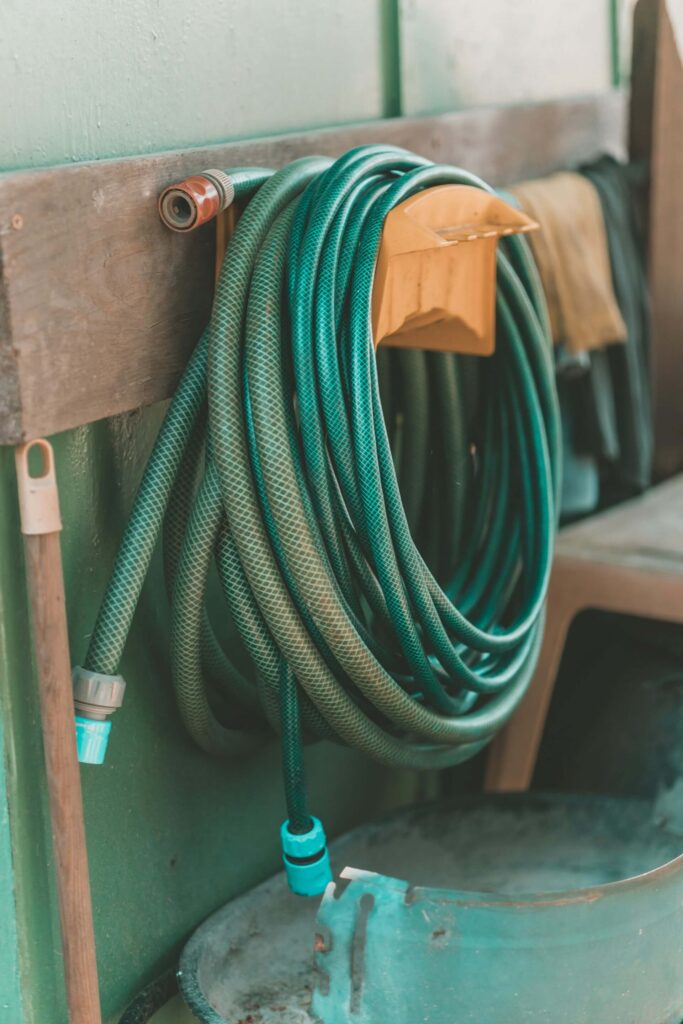
To fight the “black spot,” you need to keep the garden hose off the grass. Use a reel or a wall-mounted stand to ensure it stays dry. If the surface is already sticky, don’t scrape it—that just opens up more pores for mold to hide in. A simple melamine sponge and some diluted vinegar can act as a temporary “reset.”
Maintenance: Don’t kill your garden hose in one season.
Longevity is about placement and electrical safety. These hoses are lightweight precisely because their walls are thinner than industrial rubber. A single pass with a lawnmower will shred them. The high-visibility chartreuse color is a feature, not a fashion statement—it’s there so you don’t run it over.
- Drain It: Always drain the hose before winter. If water freezes inside, it expands and can cause micro-tears in the hybrid layers.
- UV Protection: If possible, store the garden hose on the shady side of the house. Sun is the primary killer of flexibility.
- Repair, Don’t Replace: If a fitting fails (which is the #1 failure point), buy a metal repair clamp. Avoid the “worm gear” clamps with sharp tails; your hands will thank you.
The Verdict: Is it worth the “Premium” price?
The hybrid polymer hose is a specialized tool, not a “buy-it-and-forget-it” solution. If you have back pain or a large yard, the weight savings (up to 50% lighter than rubber) are worth the price of admission. However, if you’re a “leave it in the sun 24/7” gardener, stick to traditional heavy-duty rubber. The hybrid hose requires a little more human logic to keep it from becoming a sticky, moldy mess after two seasons.